
FROM THE NOTEBOOK / PRACTICAL FIELD NOTES
Measure a glass before you batch a round
Record brim capacity, a serving allowance and real ice displacement before you scale a recipe. Work through a 180 mL glass example without treating it as a product test.
Glass & Garnish ·
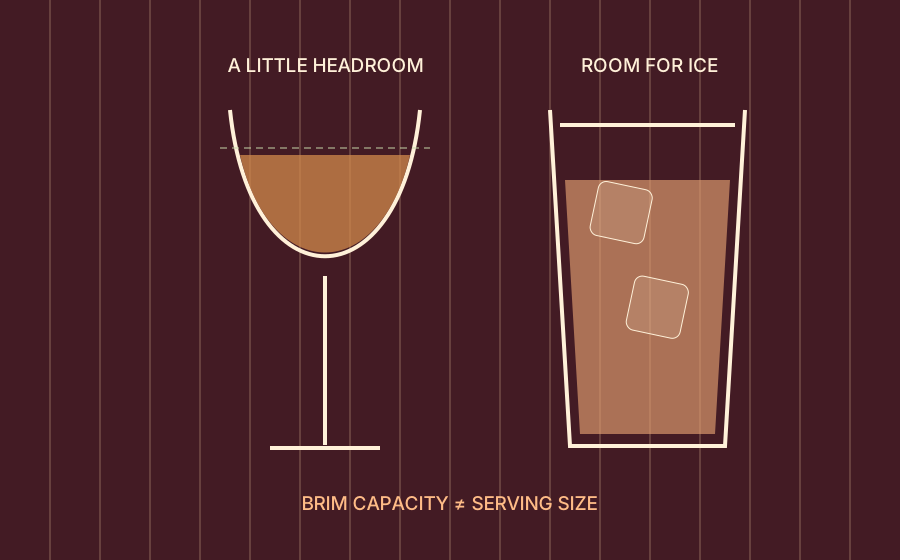
A recipe can be scaled accurately and still overflow the glass. The missing number is often the usable serving space: the glass’s measured capacity, less the allowance you want at the rim and the space occupied by serving ice. Check those numbers with one glass before multiplying the recipe.
Make a small capacity record
Use clean measuring equipment suitable for the volumes you need. Fill the empty glass with measured water to the brim and record the total. If your measure is graduated coarsely, keep the result approximate rather than adding decimal places the equipment cannot support. The number on a product listing may describe a nominal capacity; measuring your actual glass makes the next step concrete.
Choose a working allowance for carrying the glass and placing the garnish. The capacity study defaults to 15% headroom, a planning assumption you can change. It is not an industry service rule and does not mean the same physical distance below every rim.
Count the liquid after the planned water
Suppose the base formula contains 100 mL before dilution. Adding 25% of that base as water gives 25 mL more, for 125 mL of modeled liquid. In a 180 mL glass with 15% reserved, the usable allowance is 153 mL. There is 28 mL between the modeled liquid and that allowance.
If the base was 30% ABV, the additive-volume estimate is 100 × 30 ÷ 125 = 24% ABV. That is a calculation from the entered quantities, not a measurement of a finished drink. It excludes volume contraction, extraction, liquid left in tools and future ice melt.
Measure displacement rather than substituting ice weight
Ice occupies space in the serving glass. Weight alone does not give the displacement for the particular ice and liquid arrangement you will serve. Use the actual ice shape and a suitable graduated vessel to compare a known liquid level with the level after the ice is introduced. Avoid splashing or loss, and note that melting during the check changes what you observe.
As an illustrative allowance, add 60 mL of displacement to the 125 mL liquid example. The modeled occupied volume becomes 185 mL. That is 32 mL over the 153 mL allowance. A larger glass, a smaller serving or a different measured ice arrangement needs checking before the batch is prepared.
Test one serve under the intended conditions
Use the actual glass, preparation, garnish and serving ice. Confirm it can be poured and carried with the room you want. Record the water you added separately from melting that happens later. For a drink served up without ice in the glass, enter zero serving-ice displacement; chilling during preparation is a separate part of the recipe.
The glass capacity study lets you compare these figures with numerical and 3D views. The mesh is a schematic teaching object, not a scan of your glass. A volume percentage does not translate directly into the same fill height in a narrow tumbler and a broad coupe.
Only then scale the round
Use the workbench to multiply the chosen formula and prepare the shopping list. Follow the batching guide to separate a prepared base from sparkling ingredients, fresh garnish and any final shake or stir. Keep one complete per-serve record beside the batch total so the host does not have to reconstruct the pour during service.
If a trial tastes too concentrated or too dilute, return to a small comparison rather than changing the whole container. The worked dilution guide shows how the measured volume comparison is represented in the workbench. The home bar starting guide connects capacity, balance and service as a complete workflow.